
Quantum finance is a branch of econophysics, a heterodox interdisciplinary research field that involves applying theories and techniques to solve complex problems in economics.
Implementing quantum technology to financial problems — especially those dealing with nonlinear dynamics, uncertainty, or stochastic processes — can be extremely beneficial for first movers.
Faster reaction to market volatility, more accurate risk analysis, and employing behavioral data to improve customer engagement are some of the specific advantages quantum computing can deliver in the upcoming decades.
What exactly is the Quantum Financial System (QFS)?
The Quantum Financial System represents a fusion of advanced technologies, combining quantum computing and blockchain to create a financial ecosystem that promises to redefine how we perceive and interact with money.
It’s not just about adopting new, cutting-edge technology — it’s about reshaping the very foundation of modern finance.
If you’re wondering whether the quantum financial system could actually be real, the answer is yes. It may sound like science fiction, but it is based on real and developing technology.
In fact, the concept of implementing quantum money was introduced in 1970 by research physicist Stephen Wiesner. However, it remained unpublished until 1983, and a practical way of developing it (using methods from semidefinite programming) was invented in 2013.
The main idea behind the Quantum Financial System is to make the movement of money more secure and reliable, better account for uncertainty in financial models, and fix some of the problems associated with traditional central banking.
In this article, we will delve into the heart of QFS, exploring its inner workings, potential benefits, and the profound implications it holds for the financial world.
Table of Contents
Current Financial System
The financial world has changed dramatically over the past 50 years. Not long ago, cash was the most common way to pay for something. Today, we have many more options. You can use a debit or credit card, make a payment through a smartphone app, or even use a cryptocurrency wallet. The choice is yours.
Today, the world’s 30 largest banks manage more than $84 trillion in assets combined. According to the Bank for International Settlements, the global bond market is worth more than $160 trillion, with the US market alone accounting for about $61 trillion.
In such a massive and complex financial system, countless activities take place every second, from pricing securities to analyzing risk. Each of these activities requires financial institutions to assess both short-term and long-term outcomes.
To do this, financial institutions utilize advanced algorithms and machine learning models that measure statistical probabilities. However, these models are not completely accurate — we all saw what happened during the 2008 financial crisis.
Current technology still needs to mature in many ways to fulfill its promises. As a result, several financial companies are testing new processors that leverage the laws of quantum physics to process massive volumes of data at unprecedented speed. The possibilities are endless.
How Can Quantum Computing Help?

Quantum machines could transform industries that require enormous computing power. Potential applications include discovering new medicines, powering advanced neural networks, modeling financial markets, and building more secure communication systems such as the quantum internet.
In this article, we have focused on how quantum computers can improve current financial systems.
Banks, non-banking financial companies, hedge funds, and other financial institutions handle highly sensitive information, including customer transactions and contracts. Keeping this data private and secure is essential, often for many years.
Many banking activities, such as security pricing, involve a high degree of computational complexity. This complexity increases further when pricing options because it requires adapting to rapidly changing market conditions.
This is why financial institutions are constantly looking for faster and more efficient ways to price options without compromising customer data. Research suggests that quantum computing could offer a promising solution to some of these challenges.
When it comes to simulating quantum systems and running algorithms such as Grover’s search algorithm and Shor’s factorization algorithm, quantum computers can outperform classical computers for certain problems.
Basics of Quantum Computing
Quantum computers work very differently from regular computers. Classical computers use bits that are either 0 or 1. Quantum computers use qubits, which can exist in the 0 state, the 1 state, or a combination of both at the same time.
Because a quantum system can exist in multiple states at the same time (a phenomenon called superposition), it can perform far more complex tasks than classical supercomputers. This opens up vast computational possibilities.
The outcomes of quantum computation are also different from their binary counterparts. They are probabilistic (instead of deterministic), which means outputs can differ even if the input remains the same. Thus, the same computation must be done several times to make sure its results converge toward a mean.
While classical computers use bits, the basic unit of quantum information is a qubit (or quantum bit). It can be engineered as photons, electrons, or nuclei.
Examples include the polarization of a photon in which the two states can be the ‘horizontal polarization’ and ‘vertical polarization,’ or the spin of an electron in which two states can be ‘spin up’ and ‘spin down.’
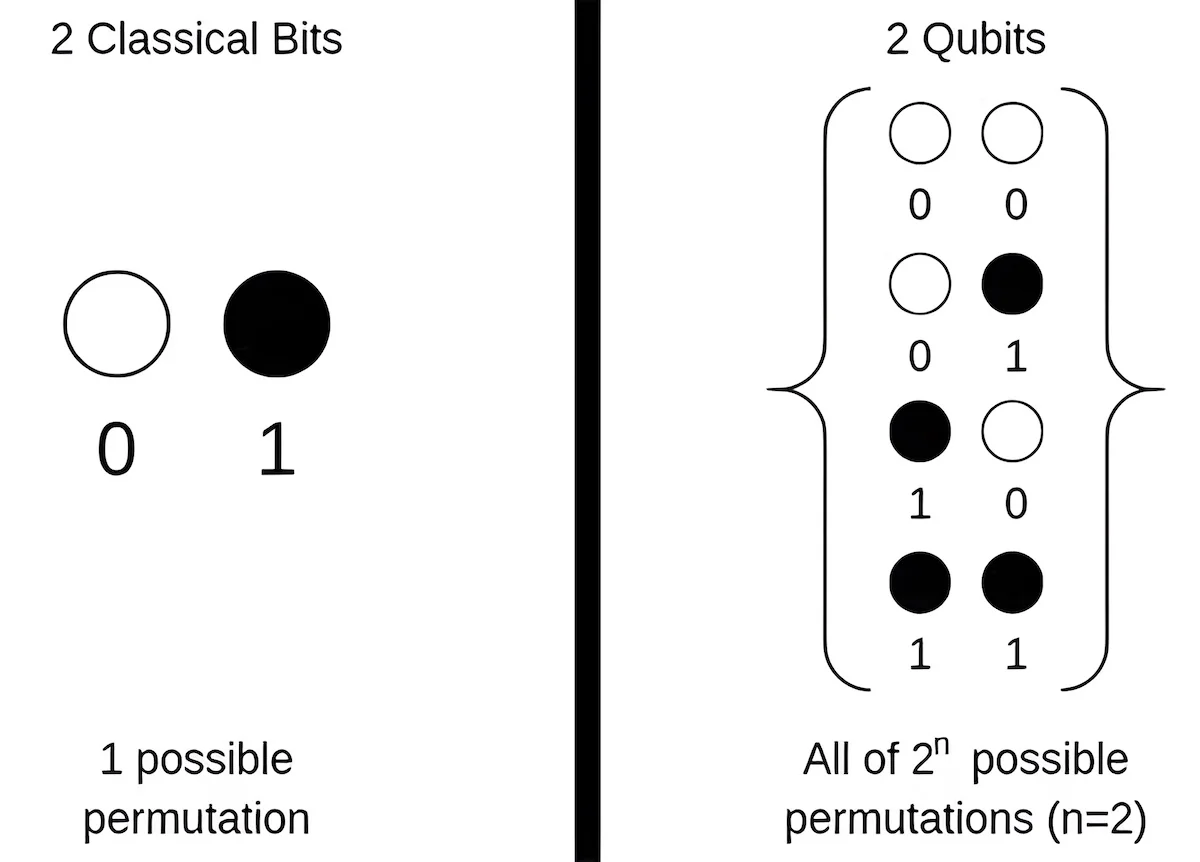
As per the quantum laws, a qubit can be in a coherent superposition of both states at the same time. For example, a two-qubit quantum computer could have ’00’ ’01’ ’10’ ’11’ states. A classical computer would require 4 bits to achieve this.
Similarly, 3 qubits can represent the same number of states as 8 binary bits, 4 qubits the same as 16 bits, 5 qubits the same as 32, 6 qubits the same as 64, and so on.
To put this into perspective, a 300-qubit system can have more states than the total number of atoms in the universe. Even the most powerful classical supercomputer could never process that amount of data.
That is why financial institutions are showing a great interest in quantum computing. While no quantum machine is yet advanced enough to perform tasks that a classical computer can’t, great progress is underway.
Read: 22 Most Interesting Facts About Quantum Computers
Quantum Money System
In the standard model of banking, money is recognized in three different forms: commodity money, fiat money, and fiduciary money.
We have also seen the rise of cryptocurrencies in the past decade, but they are not yet widely recognized. It’s a digital payment system without a central issuing or regulatory authority. Instead, it is based on a distributed public ledger known as the blockchain, a record of all transactions held by currency holders.
Quantum money takes things to the next level. It applies a quantum cryptographic protocol to generate and validate currencies. Since arbitrary quantum states cannot be perfectly copied, it is impossible to forge quantum money.
The idea looks great on paper, but it is not feasible to implement with current technology. This is because quantum money requires us to store the arbitrary quantum states in quantum memory, a quantum-mechanical version of conventional computer memory.
Although years of research and experiments have enabled quantum memory to store qubits, it can do so only for a very short time. Many research institutes worldwide are working on new materials to create memories that can hold the quantum information carried by light.
Benefits Of Quantum Financial System (QFS)
Unlike traditional computers, where doubling power requires roughly twice as many transistors, quantum computers can double power with just one additional qubit. This makes them especially advantageous for early adopters who can harness this efficiency to their benefit.
Quantum computing has the potential to empower financial institutions to address highly specific business challenges and potentially redesign certain operational processes in the coming decade.
1. Customer targeting and prediction modeling: Quantum computers are exceptionally good at finding hidden patterns in complex data structures, performing classifications, and making accurate predictions.
2. Fraud detection: Each year, financial institutions suffer substantial revenue losses, ranging from $25 billion to $50 billion, due to fraud and poor service management practices. Existing fraud detection systems are not that reliable. They return 80% false positives, leaving the banking sector at risk most of the time.
Quantum computing may offer a definitive edge in the battle against payment fraud. Its ability to harness exponential speed through quantum superposition and entanglement could reevaluate many solutions, ultimately optimizing fraud detection algorithms.
3. Client management: Quantum computing can transform client management in the financial sector by improving data analysis, security, risk management, operational efficiency, and personalization. This can lead to a seamless and highly satisfying customer experience.
4. Portfolio management: Quantum computing has the potential to speed up asset-pricing models and cultivate performance improvements. It can make a myriad of optimization calculations in a fraction of the time without using approximations.
Its combinatorial optimization capabilities could help investors improve portfolio diversification, rebalance portfolio investments according to market conditions and end goals, and efficiently streamline trading settlement processes.
5. Enhanced Security: Since QFS employs quantum encryption (an ultra-secure technique that leverages the properties of quantum physics), it can offer unparalleled security, making it extremely resistant to data breaches and financial theft.
6. Decentralization: QFS promotes decentralization, minimizing the reliance on intermediaries and lowering transaction costs. It is also designed to be globally accessible, meaning individuals and entities can engage in cross-border transactions more easily.
7. Smart Contracts: QFS supports smart contracts — these are automated agreements (encoded into computer programs) that execute themselves when predefined conditions are met. They eliminate the potential for human error, minimize the risk of disputes, and reduce the need for trust in intermediaries.
8. Reduced Settlement Risk: It is the risk that one party in a financial transaction may not meet its obligations, which may eventually lead to a failure in the settlement process. QFS mitigates this risk through near-instantaneous transactions, smart contracts, and blockchain technology that maintains a transparent and immutable ledger of all transactions.
9. Integration with Artificial Intelligence: QFS can leverage AI algorithms to improve data analytics, risk assessment, and decision-making. It can also interact with IoT devices to provide real-time data on assets, supply chains, and more.
Recent Developments In Quantum Finance
The progress made toward quantum supremacy over the past decade shows that quantum computers can outperform conventional computers at solving certain types of problems.
2014
A team of researchers from the Netherlands harnessed the capabilities of quantum mechanics to develop a fraud-proof technique for authenticating a credit/debit card that is virtually impossible to thwart.
2018
Canadian researchers published a quantum algorithm for the Monte Carlo pricing of financial derivatives, demonstrating a method to create relevant probability distributions in quantum superposition and a technique to extract the price of financial derivatives through quantum measurements.
2020
David Orrell proposed a binomial option pricing model based on a quantum walk that can be run directly on a quantum device. In the same year, D-Wave quantum computers were used to solve the Portfolio Optimization problem. The results were very promising: the performance of the D-Wave hardware (though limited in size) is comparable to superfast classical computers.
2021
A group of researchers developed quantum algorithms for high-frequency statistical arbitrage trading by using variable time condition number estimation and quantum linear regression.
2023
Researchers at IBM Quantum, in collaboration with the University of California, Berkeley, and Lawrence Berkeley National Laboratory, conducted an experiment to test the capabilities of a 127-qubit quantum computer against a state-of-the-art supercomputer. They found that despite the noise issues, quantum computers have the potential to excel in specific computational tasks.
Our paper, recently published in Nature, reveals how measurements affect a web of entangled qubits and for the first time, measurement induced quantum teleportation. ↓ https://t.co/eLOSDzC4Bh
— Quantum AI (@GoogleQuantumAI) October 30, 2023
2024
Researchers introduced the QFNN-FFD, a framework that combines Quantum Machine Learning with Federated Learning to detect fraudulent financial transactions. It achieved precision rates consistently above 95% and showed exceptional resilience, maintaining an impressive 80% accuracy even under various quantum noise models.
2025
Cisco Systems revealed a prototype quantum networking chip that utilizes quantum entanglement to enable instantaneous communication between quantum systems via entangled photons — a phenomenon Einstein famously referred to as “spooky action at a distance.
The company believes that this chip will have practical applications before quantum computers become mainstream. One immediate application is precision time synchronization for financial trades, where even nanosecond discrepancies can impact high-frequency trading outcomes. The chip could facilitate ultra-precise timekeeping, enhancing the accuracy and fairness of financial transactions.
The Present and Future Of Quantum Finance
Quantum computing technology isn’t fully developed yet. In fact, most of its benefits and applications are still conceptual. Thus, the whole banking sector is left with two choices:
- Either wait for the technology and react only when opportunities or threats are identified.
- Or start connecting with the quantum world, identify use cases, and integrate quantum security solutions.
The second option seems better. Many investment banks and financial services holding companies, including JPMorgan Chase, HSBC, and Wells Fargo, have already started pouring millions of dollars into quantum research and innovation programs.
A large body of research and engineering work has been dedicated to realizing quantum algorithms with substantial polynomial speedups in data-loading and data-processing subroutines.
So far, no practical application of quantum computing with exponential speedup over its classical counterpart has been invented, but numerous promising models have been proposed.
IBM, for example, has managed to pack 127 qubits in its proprietary quantum-computing chip. The processor uses multiple layers to host signal-carrying wires, which allow precise readouts of the qubits. Although the technique is common in classical chips, it’s a huge achievement in the world of quantum computing.
Quantum computers are expected to surpass the capabilities of classical computers by the end of 2030. Tech giants, including IBM and Google, are working on quantum machines that can hold hundreds of quantum bits.
IBM has made its aspirations more concrete by releasing a blueprint for developing quantum computers, including a goal of building a 1000-qubit computer.
Furthermore, the World Economic Forum (WEF), in collaboration with the UK’s Financial Conduct Authority (FCA), has developed a comprehensive roadmap to guide the financial sector toward quantum security. They project investments up to $850 billion over the next three decades.
This will have a disruptive impact on numerous industries, particularly finance. In fact, finance is estimated to be the first sector to benefit from quantum computing in the short and long terms.
Financial Institutions Adopting QFS
Some financial organizations have been actively studying and experimenting with quantum and blockchain technologies. The most popular ones are
JPMorgan Chase, in collaboration with QC Ware, completed a study specifically focusing on the application of quantum techniques to “deep hedging.” Deep hedging is a financial practice used to reduce risk in portfolios by employing data-driven models that take into account market frictions and trading constraints.
HSBC is the first bank to join a quantum-secured metro network established by BT and Toshiba. This network employs Quantum Key Distribution, a cryptographic technique that leverages the principles of quantum mechanics to create highly secure encryption keys. The bank is also working with Amazon Web Services to explore quantum-secured communication and data transfer in the context of AWS edge computing.
Wells Fargo‘s developers have published a series of research papers, with more to come, that outline algorithms and software solutions designed for use on quantum computers. These papers are not just theoretical concepts but practical applications tested on quantum machines.
They have also partnered with IBM, renowned academic institutions like MIT and Stanford University, and quantum-focused companies like QCWare and Oxford Quantum Circuits to advance quantum coding and testing on real quantum computers.
Goldman Sachs has undertaken well-defined benchmark problems in finance and estimated the performance specifications that a quantum computer would need to surpass in order to provide a real advantage. They have partnered with Quantum Science Laboratory and Amazon Web Services to evaluate various quantum computing applications for real-world financial problems.
Challenges
Future advancements in quantum computing within banking and financial institutions are not without challenges. The following are the major things that have to be dealt with in the coming years:
- Ensuring the reliability and scalability of quantum hardware for large-scale financial systems
- Implementing robust quantum error correction mechanisms
- Integration with existing legacy systems
- QFS adoption must comply with existing financial regulations
- Developing more energy-efficient quantum hardware
- Establishing industry standards for QFS to ensure compatibility, security, and consistency across the financial sector
In addition to these challenges, we also need to identify what problems quantum machines can efficiently solve, improve the interface for better accessibility, and extend the interest in quantum computing beyond the elite group of physicists and mathematicians.
Addressing these challenges and adopting quantum-based solutions is not a short-term process. It’s a long-term journey, and it depends on the financial sector’s capability to define problems, adjust the infrastructure, and involve skilled personnel in the process.
Frequently Asked Questions
What are the most popular quantum algorithms?
A quantum algorithm is a step-by-step instruction that can be performed on a quantum computer. The term ‘quantum’ is used for those algorithms that utilize some basic features of quantum computations, such as quantum entanglement or quantum superposition.
These algorithms can be applied in various fields, including search and optimization, cryptography, solving large systems of linear equations, and simulation of quantum systems. The five most popular quantum algorithms are —
- Shor’s algorithm factors integers in polynomial time
- Grover’s algorithm can quickly solve unstructured search problems
- Simon’s algorithm solves a specific problem exponentially faster and with fewer queries than the best deterministic classical algorithm.
- Bernstein–Vazirani algorithm was developed to prove an oracle separation between complexity classes BPP and BQP.
- Deutsch–Jozsa algorithm was the first to show that using a quantum computer as a computational tool for a particular problem can be advantageous.
When will the quantum financial system start?
The era of the quantum financial system is about to begin. Within the next decade, quantum computing will most probably become one of the mainstream solutions in the finance sector.
According to Spherical Insights, the quantum computing market size will exceed $143 billion by 2032, growing at a CAGR of 26.5%. The early adoption of quantum-based technologies in the finance sector is expected to fuel the market’s growth worldwide.
Which banks are investing in quantum computing?
J.P. Morgan, Goldman Sachs, Citigroup, Mitsubishi Financial Group, Barclays, Wells Fargo, BNP Paribas, HSBC, and Japan Post Bank — they are all pouring millions of dollars into this technology; some have started experimenting with quantum computing applications.
Can you invest in quantum computing?
Yes, there are many opportunities for investors who want to bet on quantum computing technology. A number of companies working in this area are listed on the New York Stock Exchange. A quantum computing ETF (Defiance Quantum ETF) is also available for broader exposure to the industry.
Read More


Hi, I stumbled upon this QUANTUM SYSTEM, investment company, which advertises a quantum software, which promises exaggerated earnings .. What do you think? In your opinion, is it reliable or is it just a scam? Thanks for the answer ..
Is this the best avenue for investing in the future with bitcoin and other stocks?
It’s the same coins like cbdc, it’s tided to WEF, it’s telling everything, stay away, grow your own food
Please send me more details please
please send me more information
So you don’t agree with Emily Tang of Quantum Stellar Initiative and the protocols they are teaching? I don’t see anything in your article that is anywhere close to her investigations? Where’s your evidence of what you are writing about?
Quantum Computing is great, except regarding its use for banking. Anything that is TOTALLY digital is too evanescent for hard cash dealings. They’ve almost achieved a point where AI has become too deep and fast to really understand even by its creators. Because of this and the almost complete access AI will have to ALL data, my concern is that AI could go in and figure out the vaunted block chain protocols and do with my digital money whatever IT thought was good.
Ahh YEEAAA!!!!
Just was told about QFS by some gal out of Texas. She hasn’t tried to sell me anything…YET!
A lot of reading (6pages+) from this article, I’m printing it out to read at home.
First impression, high faluting crypto with a really sophisticated digital security system against fraud. Library closes pretty soon so I’ll probably come back for more…Later!
Good morning Sirs
You can please to get me information abaut to open a QFS account and to get payment , how to do ! Thanks you very much for your help !
Truly yours
Rosita Welcker