- Benjamin Franklin gets all the credit for discovering electricity, but all he did was establish a link between lightning and electricity.
- Charles François Fay, Luigi Galvani, Alessandro Volta, Michael Faraday, Thomas Edison, and Nikola Tesla made significant contributions that led to the development and commercialization of electricity.
Electricity is all around us, powering lights, fans, computers, cell phones, and countless other devices. In today’s world, it’s almost impossible to escape it. Even if you try to escape electricity, you will find it throughout nature, from the synapses inside the human body to the lightning in a thunderstorm.
But do you know who discovered electricity? Actually, that’s quite a complicated question. Most people give credit to only one person (Benjamin Franklin), which is kind of unfair.
Many other scientists used Franklin’s experiments to study electricity, and some of them were able to invent different forms of electricity. Let’s dig deeper to find out who those scientists were and what their contributions were.
Table of Contents
Electricity Before 2,600 Years
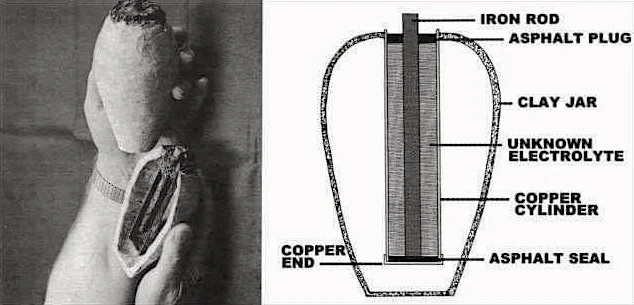 One of the instruments discovered in archeological digs near Baghdad that resembles an electrochemical cell
In about 600 BCE, a Greek mathematician named Thales of Miletus discovered that rubbing fur on amber caused an attraction between the two. Later observations showed that this attraction was due to an imbalance of electric charges, known as static electricity.
Archeologists have also discovered evidence that ancient people may have experimented with electricity. In 1936, they found a clay pot containing an iron rod, a copper plate, and an asphalt alloy. It resembles an electrochemical (galvanic) cell.
It is unclear what the instrument was used for, but it sheds light on the possibility that ancient people may have been learning about early forms of batteries long before we knew.
Thomas Browne Used The Word “Electricity” In 1646
 Gilbert’s versorium
In 1600, the English physicist William Gilbert wrote a book named De Magnete, in which he explained how static electricity is generated by rubbing amber. However, he didn’t realize that the electric charge was universal to all materials.
Since Gilbert studied static electricity using amber, and amber is called ‘elektron’ in Greek, he decided to name its effect the electric force. He also invented an electroscope (known as Gilbert’s versorium) to detect the presence of electric charge on a body.
Gilbert’s work gave rise to the English word ‘electricity,’ which first appeared in the second edition of Pseudodoxia Epidemica, a scientific journal by Sir Thomas Browne published in 1646.
Charles François Fay Discovered Types Of Electric Charges
Further research was conducted by many scientists. Otto von Guericke, for example, invented a primitive form of the frictional electrical machine in 1663. Stephen Gray distinguished between conduction and insulation and discovered a phenomenon called electrostatic induction in 1729.
One of the major contributions of the early 17th century came from a French chemist, Charles François du Fay. He discovered two types of electricity: vitreous and resinous (which are currently known as positive and negative charges, respectively).
He also discovered that objects with the same charge attract each other, and that objects with opposite charges repel. He also clarified some popular misconceptions of the time, such as the idea that an object’s electrical properties depend on its color.
Benjamin Franklin Proved Lightning Is Electrical In Nature
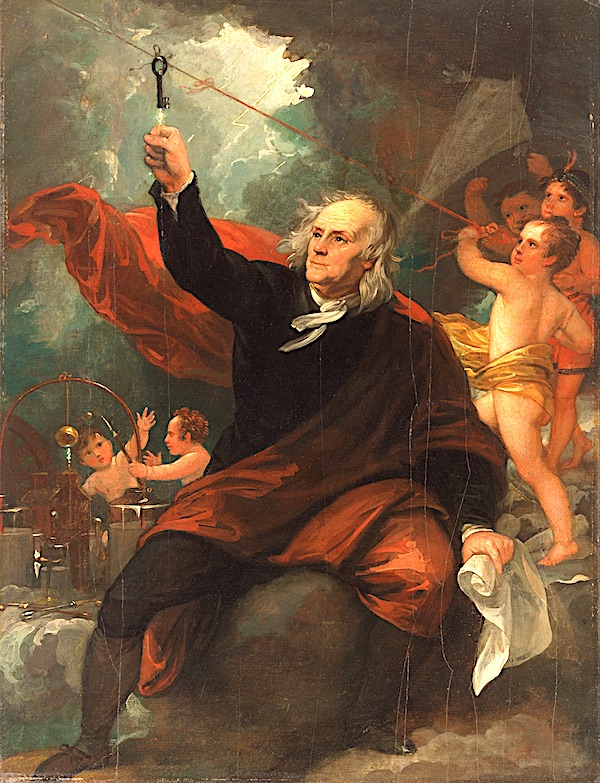 Benjamin Franklin conducting a kite experiment
In the mid-18th century, Benjamin Franklin extensively studied and performed numerous experiments to understand electricity. In 1748, he built an electrical battery by sandwiching several sheets of glass between lead plates. He also discovered the principle of conservation of charge.
In June 1752, Franklin conducted a famous experiment to prove that lightning was electricity. He attached a metal key to the bottom of a dampened kite string and flew the kite during a thunderstorm. He was careful to stand on an insulator to avoid being electrocuted.
Just as he expected, the kite collected some electric charge from storm clouds, which then flowed down the string, giving him a shock. This experiment proved that lightning was indeed an electrical phenomenon.
Luigi Galvani Discovered Bioelectromagnetics In The 1780s
Italian physicist and biologist pioneered bioelectromagnetics. In 1780, he conducted several experiments on frogs and discovered that electricity was the medium through which neurons transfer signals to the muscles.
Alessandro Volta Invented An Early Electric Battery In 1800
 Schematic diagram of a copper-zinc voltaic pile
Another Italian physicist, Alessandro Volta, discovered that certain chemical reactions could produce a steady electric current. He built the voltaic pile, an early electric battery, to produce a continuous flow of electrical charge. It was made from alternating layers of copper and zinc.
Volta also distinguished between electrical potential (V) and charge (Q), describing that they are proportional for a given object. This is what we call Volta’s Law of Capacitance. For this work, the SI unit of electric potential (the volt) has been named in his honor.
The research conducted by Volta attracted significant attention and prompted other scientists to conduct similar investigations, which eventually led to the development of a new branch of physical chemistry called electrochemistry.
The German physicist Georg Simon Ohm further studied Volta’s electrochemical cell and found that the electric current is directly proportional to the voltage (potential difference) applied across the conductor. This association is called Ohm’s law.
Hans Christian Ørsted Found That Electricity Creates Magnetic Fields
 Portrait of Hans Christian Ørsted
In the early 19th century, Danish physicist Hans Christian Ørsted found a direct relationship between electricity and magnetism. In 1820, he published his findings, describing how a compass needle could be deflected by a nearby electric current.
Ørsted’s work inspired French physicist André-Marie Ampère to develop a physical and mathematical theory that could better explain the connection between electricity and magnetism. He formed a mathematical formula to represent the magnetic forces between current-carrying objects. For this work, the SI unit of electric current (ampere) is named after him.
Ampère invented numerous instruments in the 1820s, including the solenoid (an electromagnet that produces a controlled magnetic field) and the electrical telegraph (a point-to-point text messaging system).
Michael Faraday Made Electricity Practical For Use In Technology
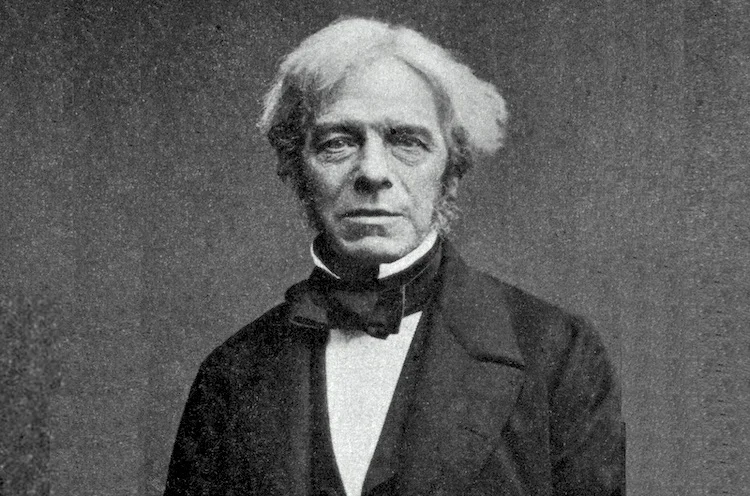 Michael Faraday, aged about 70
Michael Faraday established the foundation for the concept of the electromagnetic field. He discovered that light rays could be affected by magnetism. He invented electromagnetic rotary devices that formed the basis of electric motor technology.
In 1831, Faraday developed the electric dynamo — a machine that could continuously convert rotational mechanical energy into electrical energy — which made producing electricity feasible.
In 1832, Faraday conducted a series of experiments to investigate the behavior of electricity. He concluded that the categorization of different ‘types’ of electricity was illusory. He instead proposed that there is only one ‘type’ of electricity, and altering parameters, such as current and voltage (quantity and intensity), would create different groups of phenomena.
James Clerk Maxwell Formulated The Theory Of Electromagnetic Radiation
In 1873, the Scottish scientist James Clerk Maxwell began developing equations to describe the electromagnetic field accurately. He theorized that electric and magnetic fields move as waves at the speed of light.
Heinrich Rudolf Hertz conclusively proved this theory, and Guglielmo Marconi used these waves to develop radio.
Thomas Edison Commercialized Electricity
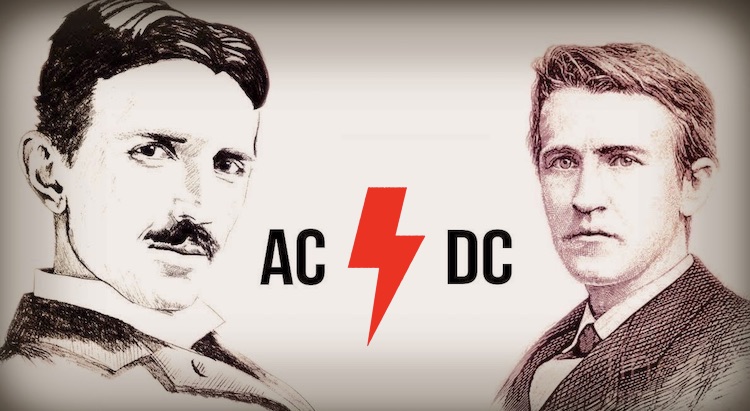
In 1879, Thomas Alva Edison invented the practical light bulb that would last a long time before burning out. His next challenge was to develop an electrical system that could provide people with a feasible energy source to power these light bulbs.
In 1882, he built the first electric power plant in London to generate electricity and carry it to people’s homes. A few months later, he established another power plant in New York City to provide electric lighting in Lower Manhattan. About 85 customers received enough power to light 5,000 bulbs.
The plant used reciprocating steam engines to turn direct-current (DC) generators. But since it was a DC distribution, the service area was limited by voltage drop in the feeders.
Nikola Tesla Invented Alternating Current
The turning point of the electric era came a few years later when Nikola Tesla arrived in New York to work for Edison. He left Edison Machine Works after six months because of unpaid bonuses he believed he had earned.
Soon after leaving the company, Tesla discovered a new type of alternating current (AC) motor and electrical transmission technology. He teamed up with George Westinghouse to patent the AC system to provide the nation with superior electric energy.
The power system invented by Tesla rapidly expanded in the United States and Europe due to its advantages for long-distance, high-voltage transmission. Tesla’s first hydroelectric power plant in Niagara Falls could transport electricity over 200 square miles. In contrast, Edison’s DC plant could only transport electricity within one mile.
Today, alternating current is generated by most of the power plants and used by almost all power distribution systems. The total worldwide gross electricity production was 30.85 petawatt-hours (PWh) in 2024.
Read: 12 Ingenious Nikola Tesla Inventions In Various Fields
Heinrich Hertz Observed The Photoelectric Effect In 1887
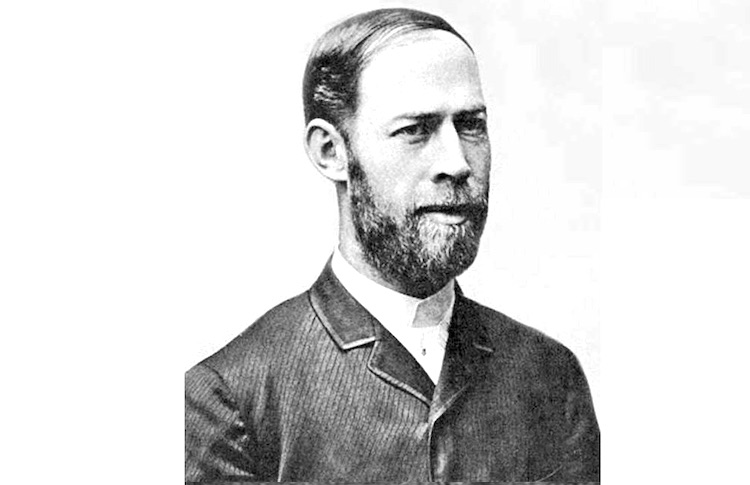 Heinrich Rudolf Hertz
While Tesla was busy inventing and distributing alternating current, Heinrich Hertz was performing a series of experiments to understand electromagnetic waves. In 1887, he observed the photoelectric effect, a phenomenon in which electrons are emitted when electromagnetic radiation (such as light) hits a material.
In 1905, Albert Einstein published the ‘law of the photoelectric effects’, advancing the hypothesis that light energy is carried in discrete quantized packets. It was a crucial step in the development of quantum mechanics. For this work, Einstein was awarded the 1921 Nobel Prize in Physics.
The photoelectric effect is used in photocells commonly found in solar panels. These cells produce a voltage and supply an electric current when sunlight (or light with certain wavelengths) shines on them.
By the end of 2024, the world had almost 7 billion solar panels installed, totaling around 2 terawatts (TW) of capacity. In the first six months of 2025 alone, another 380 GW of solar capacity was added, a big jump of 64% compared to the same period in 2024.
The number will increase in the coming years as many countries and territories shift to renewable sources to reduce the environmental impact of electricity generation.
And so, it would be wrong to credit only one person for discovering electricity. While the idea of electricity existed for thousands of years, when it came time to study it scientifically and commercially, several great minds worked on different subsets of the problem.
Read More