Whether you are starting a new business or scaling a small startup, the first and most important step is to legally register your company. To do that, you need to choose an ownership structure that supports your business needs and goals. Below are eight main types of business ownership that you must know before registering your business.
Table of Contents
8. Sole Proprietorship
As the name suggests, a sole proprietorship is a business structure in which a single individual, or sole trader, runs and owns the business. It is the most uncomplicated form of business ownership.
Requirements include registration with related authorities (depending on the country), which protects the business name from being copied and allows the owner to hire employees.
Advantages
Simple and easy: Registering a business as a sole proprietorship is perhaps the simplest of all. The only paperwork includes a simple registration and the relevant licenses to conduct business. It is also the least expensive type of business ownership.
Complete control: As the only owner, sole proprietors have complete control over their business and business decisions—no general meetings and votes.
Simplified taxation: Sole proprietorships are not subjected to separate taxation, as profits from these businesses are legally assessed as the owner’s personal income and thus are only liable for a single tax.
Disadvantages
Full legal/financial liability: There is no legal distinction between a sole proprietor and their business. It means that if legal action or a lawsuit is filed against a sole proprietorship, it will be personally pursued against the owner. Similarly, if the business defaults on its loans/credits, the owner’s personal property and assets can be seized by creditors to recover their claims.
Limited funding options: In most cases, sole proprietorships do not qualify for loans or other types of business funding from traditional institutions, including banks, due to high credit risk. It makes it difficult for such businesses to acquire large amounts of funding.
Sole Proprietorship in the United States
In the U.S., sole proprietors are not required to register their business. However, depending on the industry, they may need to obtain licenses to conduct business operations.
Under the 2017 Tax Cuts and Jobs Act, sole proprietorships and other flow-through entities are qualified for up to 20 percent tax deductions from income.
What is A Flow-through Entity?
A flow-through or pass-through entity is any legal business organization whose profits are treated as direct income of its members or partners. Such entities avoid double taxation (corporate income tax) because their members are taxed only on their flow-through income.
Sole Proprietorship in Europe and other parts of the world
Most European countries, including the United Kingdom, require individual owners (sole proprietors) to enroll for the Value Added Tax (VAT). Owners become liable for VAT or GST after they reach a set annual revenue threshold. This system is also practiced in Australia and Malaysia.
7. Partnership
A partnership, in its most basic form, is any business owned by two or more individuals. If two people start a new business venture without registering with the local authorities, that business will be considered a partnership by default.
While not a legal requirement, partnerships are often formalized through partnership agreements that outline each partner’s rights and obligations. Partnership agreements can also be drawn up between two separate companies before a joint venture or consortium is formed.
There are two forms of partnerships: general partnership and limited partnership. A limited partnership is different from a limited liability partnership, which we will discuss in the next segment.
Anyhow, the difference between a general partnership and a limited partnership is that the latter has at least one general partner and at least one limited partner (with no management authority or liability). Business entities such as law firms and accounting firms are typically organized as partnerships.
Advantages Of Partnership
Simplicity: Partnership businesses enjoy the same advantages as those of Sole Proprietorships. It doesn’t require any legal formalities or paperwork for registration except for partnership agreements. As a flow-through, partnership entities do not pay corporate taxes.
Full control: In partnerships, owners enjoy full control over every aspect of their business. New partners can be easily introduced in this ownership structure.
Disadvantages Of Partnership
Financial risks and liabilities: Joint owners in a partnership are fully exposed to legal/financial liabilities that may arise during the company’s operations. However, these risks can be reduced to some extent by insurance policies and carefully negotiated partnership agreements.
Partnership Laws in the United States: Unlike most nations, partnerships are not federally regulated in the U.S. Instead, each state has its own set of written laws that govern such businesses.
Under the Uniform Partnership Act (including the 1997 revision), many U.S. states have adopted standard or similar regulations regarding the formation, assets, and liabilities of general partnerships and limited liability partnerships.
6. Limited Liability Partnership (LLP) And LLLP
 Kirkland & Ellis LLP, the world’s largest law firm by revenue, has an office in Palo Alto
A limited liability partnership (LLP) is a modified version of the limited partnership business structure in which partners enjoy the simplicity of flow-through taxation rules while retaining limited liability. It can be described as a hybrid business ownership structure with elements of partnerships and corporations. However, unlike limited partnerships, LLPs are not available in every nation.
Advantages Of LLP
Liability protection: Unlike in ordinary partnerships, partners in an LLP have limited liability. It means that every partner’s liabilities are limited to their investment in the business and do not extend to their personal assets. Moreover, each partner of an LLP is not personally liable for another partner’s negligence.
Flexibility: LLPs are considered flow-through tax entities, meaning they are not subjected to corporate income tax.
Disadvantages Of LLP
Complexity: Often, partners in an LLP are required to establish complex sets of regulations and provisions that outline each partner’s responsibilities and the business decisions they can and cannot take. Furthermore, many U.S states have a complicated tax filing system in place for LLPs, which could be a disadvantage.
Availability issues: Not all U.S states recognize the limited liability partnership ownership structure.
LLPs in the United States: Not all states allow businesses to register as limited liability partnerships. And each state has its own rules regarding the formation of an LLP and the liability of its partners.
For instance, in California and Nevada, LLPs can only be used by professional services, such as accounting, architecture, and law firms. LLPs usually require registration with the office of the Secretary of State.
In some states, such as Delaware, Texas, and Virginia, businesses can register as limited liability limited partnerships (LLLPs). This is a modified form of a limited partnership that protects general partners from personal liability for the partnership’s debts and obligations.
5. Limited Liability Company (LLC)
A limited liability company can be best described as a hybrid business entity with traits of both partnerships (or sole proprietorship) and corporations. It combines the flow-through taxation feature of partnerships with the limited liability status of corporations. However, the most important characteristic of LLCs is their flexibility.
Under the limited liability company structure, a business may elect its corporate tax status; whether it should be taxed once before the distribution of its income among the members and then again after the income is distributed (double-taxation as in C corporations), or that the profits (or losses) flow through to the members (as in S corporations).
Flexible taxation, along with the limited liability for owners, makes the LLC a popular choice among small businesses.
The ‘limited liability company (LLC)’ is a U.S specific form. In most other english speaking countries, such ownership structure is known as private limited company.
Advantages of LLCs
Limited liability: By forming an LLC, owners can legally separate the business entity from their personal assets. Members are partially or completely (depending on local laws) shielded against any legal action or credit claims that are brought against an LLC. However, members of LLCs can incur personal liability under certain circumstances.
Flexible tax system: A multi-member LLC can choose how it is taxed. It may be taxed as a pass-through entity, like a partnership or S corporation, or it can opt to be taxed as a C corporation, which is subject to federal corporate income tax.
Flexible ownership: Several U.S states allow LLCs to be formed by a single person. States also do not restrict the number or type of members an LLC can have. Members can be individuals, organizations, or other businesses.
Disadvantages of LLCs
Unclear regulations: One of the biggest disadvantages of LLCs is their unclear or complex management structure. Unlike corporations, which usually have clearly defined state laws and provisions for both the shareholders and the business entity, most states do not provide adequate protective laws and regulations for LLCs.
In such cases, it is critical for the members of an LLC to establish the ‘operating agreement,’ a rule book of sort that outlines rules and provisions for the internal operations for the company.
Jurisdiction issues: A U.S.-based LLC is usually treated as a corporation, which is subject to additional taxes when operating outside the United States. This happens in countries where the limited liability company structure is not legally recognized, such as Canada.
Different Variations of LLCs
Several variations of LLCs have emerged over time. A few of them are as follows,
Series LLC
A Series LLC is a specialized, more complex form of the LLC ownership structure that allows a business to compartmentalize or isolate its assets. In essence, a business organized as a series LLC can create multiple secondary LLCs that act like subsidiaries.
By legally isolating each of its assets and business units into these subsidiary LLCs, a series LLC can ensure that foreclosures and legal liabilities of one business unit remain restricted and do not affect its other assets.
L3C
The L3C, or low-profit limited liability company, is a business structure that allows social enterprises to attract private investment while generating small profits from their operations. An L3C is essentially a hybrid entity that enjoys the legal and financial flexibility of a standard LLC and the social status of a nonprofit organization.
4. C Corporation
 Walmart Inc., the world’s largest company by revenue
A corporation is a business entity that is legally separate from its owners, who have a varying level of control over its operations. These owners can either be classified as members or shareholders, depending on the type of corporation.
A corporation’s management structure lets owners share in the profits while protecting them from personal liability for the company’s debts and legal issues.
To form a corporation, a business usually needs to file articles of incorporation with the relevant state and then appoint or elect a board of directors to oversee its day-to-day operations.
Depending on its tax classification, a corporation can be classified as a C corporation (C corp) or an S corporation (S corp). A C corporation is subject to double or separate taxation: its business profits are first taxed at the corporate level (corporate income tax), then at the personal level after distributing its earnings and profits to shareholders.
C corporations are incorporated under the tax rules defined by Chapter 1, Subchapter C of the Internal Revenue Code. Every new corporation, by default, is treated as a C corporation unless it elects to be treated as an S corporation.
Advantages of a C corporation
Limited Liability: Both C corporations and S corporations allow shareholders or members to limit their liability up to their investment in the business. They are personally liable for the business’s commitments and obligations to third parties.
Business Scalability: C corporations have no shareholder limit. It means that a C corporation can have any number of shareholders, allowing the business to expand at a fast pace without structural changes. All publicly traded corporations are C corporations
Easy access to investments: Corporation business ownership structures are much better at attracting investments from different sources than sole ownership and partnerships.
Disadvantages of a C corporation
Tighter regulations: Unlike LLCs or more informal ownership structures, C corporations are required to file their earnings, profits, and other business metrics at regular intervals. They are subjected to tighter oversight than LLCs.
Double taxation: C corporations are taxed at two levels: first at the corporate level and then at the personal level. A C corporation pays corporate income tax on its revenue before the distributions of its profits (usually defined as dividends in the U.S) among shareholders, who then pay personal income taxes on those gains.
Less individual control: The management structure of C corporations, which includes a board of directors and many shareholders, limits any one individual from controlling the entire business.
3. S Corporation
Unlike C corp, an S corporation is treated as a flow-through taxation entity that does not pay corporate income tax. Instead, the profits (or losses) are directly passed through to its shareholders, who then file individual income tax returns on that income.
S corporations are taxed under Subchapter S of the IRC and are ideal for small businesses. A C corporation can choose to be taxed as an S corporation if certain conditions are met.
Advantages Of an S Corporation
Limited Liability: Like C corporations and LLCs, the S corporation structure creates a legal distinction between the business and its owners, thereby limiting their liability.
Easy taxation: As flow-through entities, S corporations do not pay corporate income tax, relieving them of additional tax filing burdens.
Disadvantages of an S Corporation
Management restrictions: An S corporation can have no more than a hundred shareholders at a time. And those shareholders must be residents or U.S citizens. Moreover, such corporations can only issue a single type of stock.
Complex state laws: Several U.S states, including California, Delaware, and Pennsylvania, require businesses to fulfill certain requirements to be recognized as an S corporation. For instance, the Franchise Tax Board of California imposes a 1.5% franchise tax on the income of every S corporation in the state.
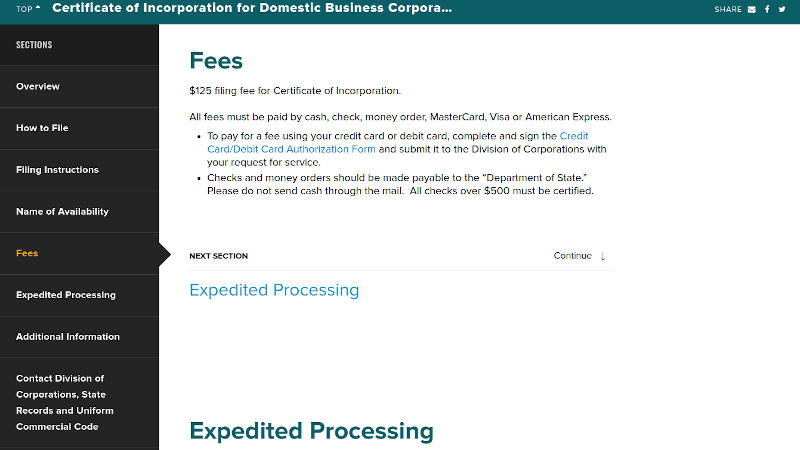 New York corporate website
The New York State does not recognize S corporation as a flow-through tax entity meaning such corporations are required to pay corporate tax like C corporations.
2. Benefit Corporation Or B Corp.
A benefit corporation (B.corp) is a corporate entity that has declared to pursue social and environmental activities on top of focusing on corporate profits and the appreciation of shareholder value over the long term.
Benefit corporations are almost similar to C corporations except for a major difference. While ordinary corporations can also make social and environmental commitments, they usually avoid such decisions because of their foremost legal obligation to maximize shareholders’ profits.
A benefit corporation addresses this problem by extending the legal obligation of the board of directors to pursue the interests of non-financial stakeholders, including employees and customers.
A corporation may convert into a benefit corporation by amending its bylaws to state that it is a public benefit corporation. The firm must also specify the social benefit projects that it will pursue.
Advantages Of B.Corp
Limited Liability: Like other types of corporations, benefit corporation stakeholders also enjoy limited liability.
Tax benefits: While public benefit corporations must abide by the tax regulations of either C corporation or S corporation, they enjoy regular tax deductions due to their philanthropic contributions to society.
Disadvantages Of B.Corp
Restricted availability: As of July 2021, the benefit corporation structure is legally recognized in only 37 U.S states. Plus, each state has its own rules for forming a benefit corporation and reporting its social impact, which makes this type of business more complex to set up and manage.
Read: 16 Biggest and Most Valuable Fintech Companies in the World
1. Nonprofit Organization
A nonprofit organization or institution is any legal entity that works exclusively on charitable missions. Unlike other types of business ownership on this list, nonprofits are not profit-driven and operate solely on donations, government funding, corporate sponsorships, fundraising, and merchandise sales revenue.
Contrary to popular beliefs, a nonprofit organization can make profits. As a matter of fact, nonprofits are required to be fiscally responsible and, in many cases, are urged to act more like a business.
Nonprofit Corporation in the United States
In the United States, incorporation for nonprofit entities is the same as for other corporate types, including filing the articles of incorporation with the Secretary of State and appointing a board of directors or trustees.
A nonprofit corporation may qualify for federal income tax exemption under Section 501(c) of the Internal Revenue Code. However, because tax-exempt status is granted by the federal government, not all incorporated nonprofit organizations are automatically exempt from taxes.
Read: 9 Helpdesk Software For Small Business
Frequently Asked Questions
What Is Ownership Interest?
Ownership interest is any stake owned by an individual or an entity in a business, real estate, or other types of assets. In LLCs and corporations, stakeholders have varying ownership interests. In sole proprietorships, only one individual has ownership.
In business, ownership interest is usually divided into two types: passive interest, where an investor owns less than 20% of the company, and controlling interest, where ownership is 50% or more.
What are the Main Types of Business Ownerships?
The main types of business ownership that are recognized in most countries are sole proprietorship, partnership, and limited liability company (LLC). Corporation, on the other hand, is a U.S.-specific form of ownership structure.
In the United Kingdom, corporation-like business structures are formally known as PLC or public limited company. In countries like France, Spain, and Poland, they are designated as S.A.
Read: 8 Best Banks For Small Business and Startups
What is the Best Legal Form of Business Ownership?
When considering limited liability, ownership structures such as limited liability partnerships, limited liability companies, and corporations are ideal for your business. However, such forms of ownership have complex rules and regulations that must be adhered to.
When choosing an ownership structure, business founders should carefully evaluate the advantages and disadvantages of each option and how it fits their company’s needs.
Read More