- Although Johann Zahn is generally credited with inventing the camera, it was the culmination of work done by many individuals and private companies.
- Joseph Nicephore Niepce, Louis Daguerre, Alphonse Giroux, and George Eastman made significant contributions that led to the development of an advanced camera.
The history of the camera dates back to the 11th century, when the Arab physicist Ibn al-Haytham described the principles of optics in his books and conducted experiments involving passing light through a small opening in a darkened room.
Ibn al-Haytham made significant contributions to the principles of optics and visual perception, which is why he is often referred to as ‘the father of modern optics’. He was the first to describe that vision occurs in the brain, rather than in the eyes.
Table of Contents
11th Century: Ibn al-Haytham invented the Pinhole Camera
Ibn al-Haytham is credited with inventing the pinhole camera. He gave an accurate analysis of a phenomenon called Camera Obscura. It is the effect by which light shining through a small hole can show an image on the opposite surface.
 A pinhole camera is a small, dark box in which light enters through a tiny hole and forms an inverted image on the opposite surface.
Ibn al-Haytham used a screen in a dark room so that the picture from one side of the surface’s hole could be projected onto a screen on the other side. He also explained the relationship between the pinhole and the focal point.
1685: Johann Zahn Designed The First Portable Camera
Johann Zhan proposed a handheld instrument with a mirror-reflex mechanism, a design that would later be utilized to build photographic cameras.
He designed many portable camera obscurae and built one that was 48 centimeters long. He also demonstrated the use of lenses and mirrors to enlarge, focus, and erect the image.
Not much progress was made in the next 130 years. Most of the attempts and techniques to build cameras in between were ineffective.
1825: Joseph Nicéphore Niépce captured the first photograph
Since 1816, the French inventor Joseph Nicephore Niepce had been experimenting with techniques to improve the image quality of a camera obscura. It wasn’t until 1825 that he took the first photo with a sliding wooden box camera.
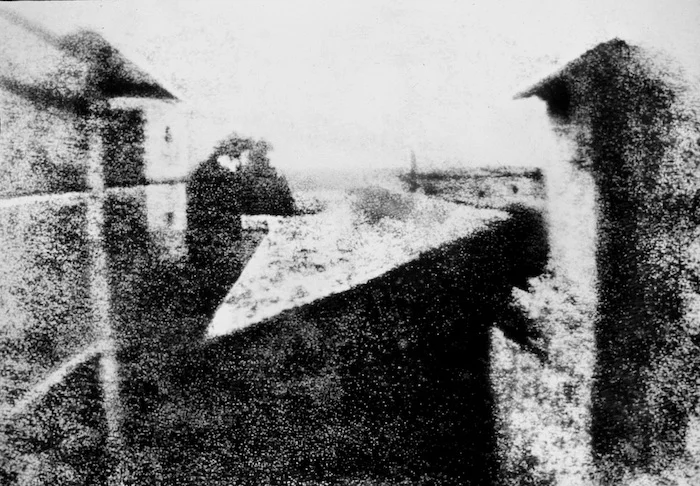 The earliest surviving photo | View from Niepce’s window
The image he clicked shows the view from his window at Le Gras. The photo took nearly 8 hours to form on the paper. And since it was light-sensitive, it gradually turned dark. Niepce called this 8-hour process “heliography“.
Generally, he is credited with inventing photography and as a pioneer in the field.
1837: Louis Daguerre invented practical photography
Louis Daguerre and Joseph Nicéphore Niépce formed a partnership to enhance heliography. They both experimented with various chemicals to refine the contrast in heliographs.
Although their partnership ended in 1833 after Niépce’s death, Daguerre went on to create very sharp, high-contrast images by exposing a silver-iodide-coated plate and then developing it with mercury vapor.
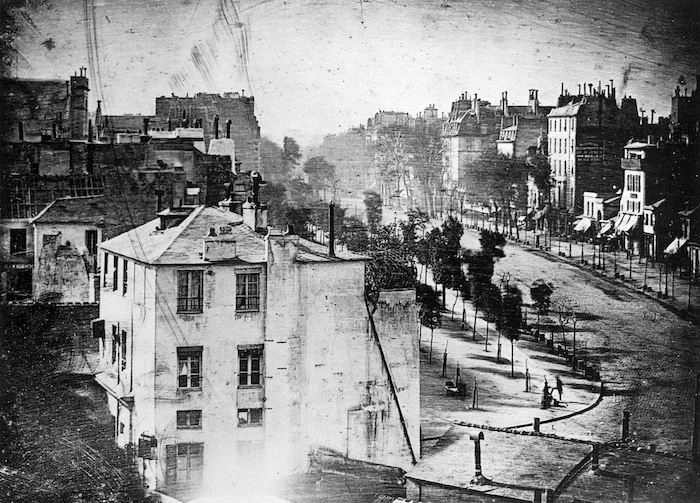 The earliest-known photo of a person, captured by Daguerre in 1838. It’s a view of the Boulevard du Temple in Paris.
He continued experimenting and successfully fixed the photos with a common salt solution. This process was named Daguerreotype. In 1839, Daguerre went public with this invention, but he wasn’t able to successfully commercialize it. A few years later, the French government acquired the daguerreotype process for public release.
Today, Daguerre is recognized for inventing the daguerreotype process and is known as one of the fathers of photography.
1839: Alphonse Giroux built the first commercially manufactured camera
Alphonse Giroux is known for constructing the first commercially manufactured daguerreotype camera. He made a deal with Louis Daguerre to build the cameras in France.
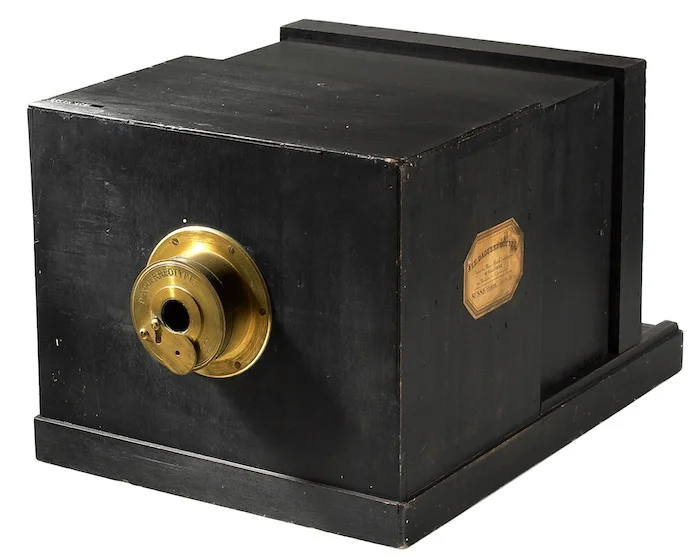 A daguerreotype camera | Image credit: Wikimedia
The camera featured a two-box design: the inner box was fitted with an image plate, and the outer box had a landscape lens. The inner box could be slid to focus on objects at varying distances.
After focusing the image on the screen, a sensitized plate was placed on it. The shutter of the camera was a copper flap fixed in front of the lens, controlled by a knurled wheel.
These cameras used to take 5 to 30 minutes to capture a single photograph. Each device (with accessories) was priced at 400 francs.
Mid 19th Century
Soon after the daguerreotype camera came onto the market, many companies began developing improved variations. For example, in 1841, Charles Chevalier utilized a half-sized plate to build a two-box camera. This increased portability and reduced exposure times to 3 minutes.
By 1851, Americans were using three forms of cameras: the Lewis-type camera, the Boston box, and the chamfered-box camera.
Over the next three decades, more sensitive and higher-quality imaging materials were developed, allowing cameras to use mechanical shutters and capture photos in seconds instead of minutes.
Read: 11 Thomas Edison Inventions That Everyone Should Know
1889: George Eastman brought the photographic use of roll film into the mainstream
George Eastman was the pioneer of popular photography and motion picture film. In 1885, he began manufacturing roll film, a form of spool-wound photographic film protected from white light exposure by a paper backing. Roll film played a crucial role in the invention of motion picture film stock in 1888.
 The original Kodak camera with the case, felt lens plug, and manual | Wikimedia
Eastman’s first camera, named Kodak, went on sale in 1888. It was a low-priced box camera with a single shutter speed and a fixed-focus lens. Since the camera included enough film for up to 100 exposures, it attracted many customers.
Once the roll was finished, customers were required to send it back to The Eastman Kodak Company for processing and reloading. Within a decade, the company had expanded its lineup to different models, including folding and box cameras.
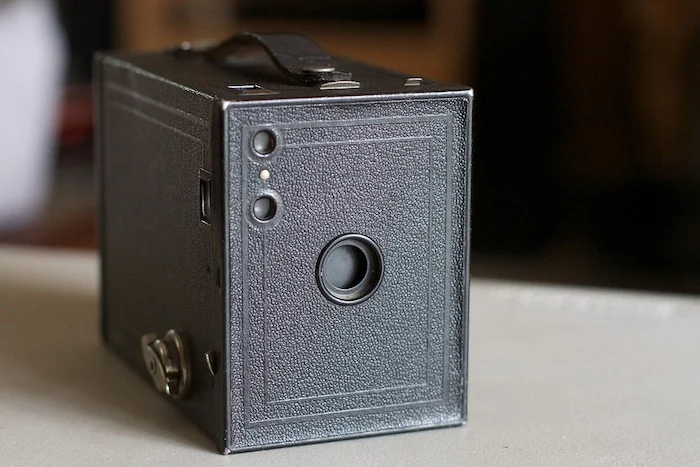 Brownie 2
In the very early 19th century, Eastman released another inexpensive box camera named Brownie, introducing the concept of the snapshot to the masses.
1948: Edwin Herbert Land Invented “In-Camera Instant Photography”
Edwin Herbert Land was an American scientist who created affordable polarizing filters and developed a practical instant-camera system. His invention made it possible to take a picture and have it developed in under a minute.
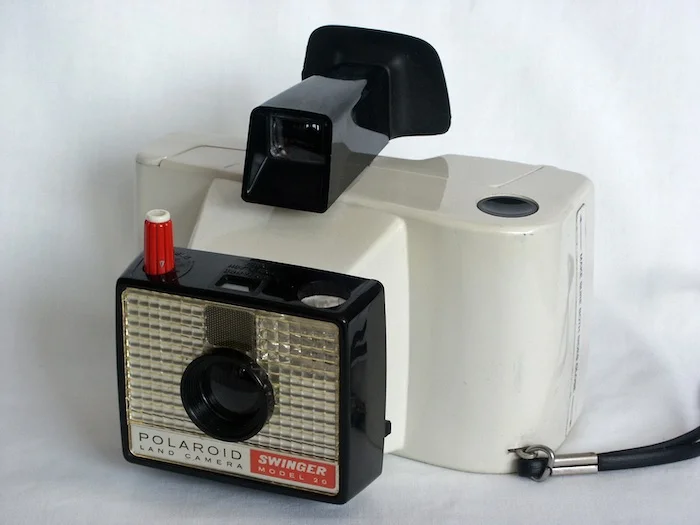 Model 20 Swinger | Image credit: Wikimedia
By the 1960s, his company, Polaroid Corporation, had manufactured dozens of models. One of those models was the Model 20 Swinger (developed in 1965), which still remains one of the highest-selling cameras of all time.
1975: Steven Sasson Invented The First Portable Digital Camera
Steven Sasson developed a self-contained digital camera while working at Eastman Kodak. It weighed 3.6 kilograms (8 pounds) and had a resolution of 0.01 megapixels. It could capture pictures in black and white, which were stored on a cassette tape. The overall process took 23 seconds.

With this invention, Sasson opened new avenues for camera designs without mechanical moving parts (although his camera did include moving components, such as a tape drive).
From this point onward, many companies (including Sony, Canon, Nikon, Panasonic, and Philips) were involved in developing advanced hardware and techniques to achieve superior image quality. The progress made included color photography, higher-resolution images, smaller devices, and more sensitive sensors.
In 1999, Japanese electronics manufacturer Kyocera introduced the first commercial camera phone. It had a 0.1-megapixel front-facing camera and could store up to 20 JPEG photos. One year later, Samsung introduced the SCH-V200 phone with a 0.3-megapixel rear camera and an LCD display.
Read More